“We hope soon to convince them all that we are not a bunch of outlaws, but a people who mean to do right as far as our knowledge will lend us.” – John Sevier, 1785.
After eight years, the Revolutionary War ended in September 1783 with the signing of the Treaty of Paris. The Treaty of Paris, signed by representatives of the United States and Great Britain, formally recognized the United States as an independent nation. It also outlined the United States’ territorial boundaries, allowing western expansion. The now formally recognized independent country’s northern border was established to run along what is presently known as Canada through the Great Lakes; the eastern border was defined by the Atlantic Ocean, the southern border stopped where Spanish Florida began, and the Mississippi River acted as its western border, separating the United States from Spanish-held Louisiana. At this time, Vermont was technically an independent, sovereign republic; however, it was pictured inside United States borders.
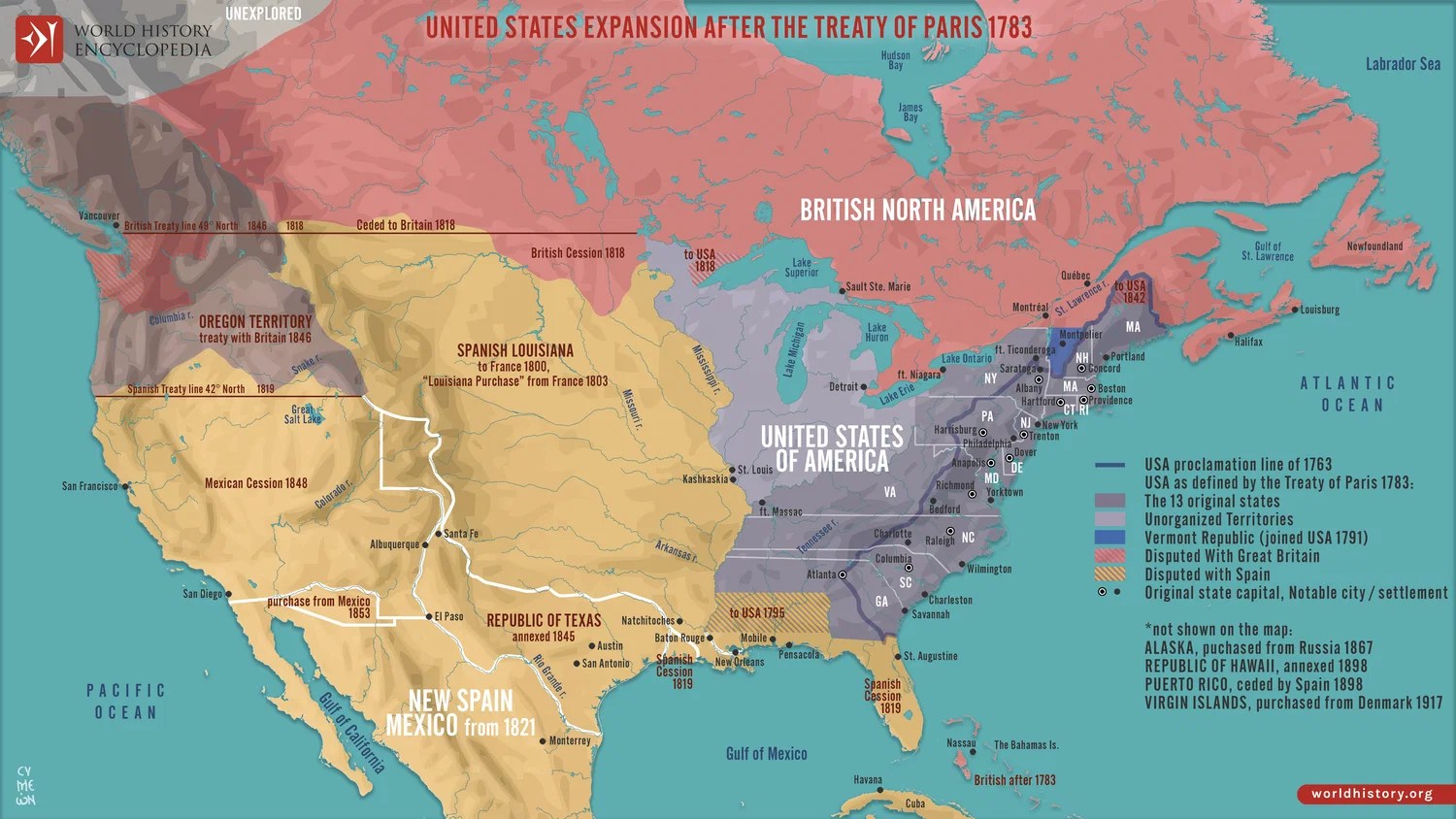
Despite U.S. expansion, communities between the Mississippi River and the Appalachian Mountains didn’t automatically become integrated into the United States. This region was detached from the control of the new federal government and, while the United States legally owned this land on paper, it lacked what was needed to control it. Because of this, communities in the region were given leeway to create their own jurisdictions within state lines, form new states within the Union, or create their own sovereign republics if they wanted to. Among the attempts at any of the three options, the state of Franklin was the most advanced effort.
In 1783, North Carolina’s western territory spanned from the crest of the Appalachian Mountains to the Mississippi River, and contained two established settlements: the Watauga settlement and the Cumberland settlement. Lying along the Watauga and Nolichucky rivers, the Watauga settlement was the closest of the two to the Appalachian Mountains. Its ties to North Carolina’s government, however, were still weak. It was large, established, and included three county governments and several thriving towns that served the needs of around 5,000 inhabitants. The Cumberland settlement was farther west, smaller, and was the target of constant, severe attacks by Native American tribes.
Like every other state in the Union, North Carolina came out of the Revolutionary War carrying debt. To liquidate its debt, the state’s legislature passed the Land Grab Act in April 1783. This act opened all of North Carolina’s western lands for sale. Rife with insider trading and outright fraud, four million acres were claimed between October 1783 and May 1784, with three million of these acres being claimed by North Carolina legislators or said legislators’ business partners. After the selling window closed, in June 1784, North Carolina voted to surrender its western lands to the federal government, adding a provision guaranteeing that all land warrants issued under North Carolina law were valid, regardless of fraudulence.
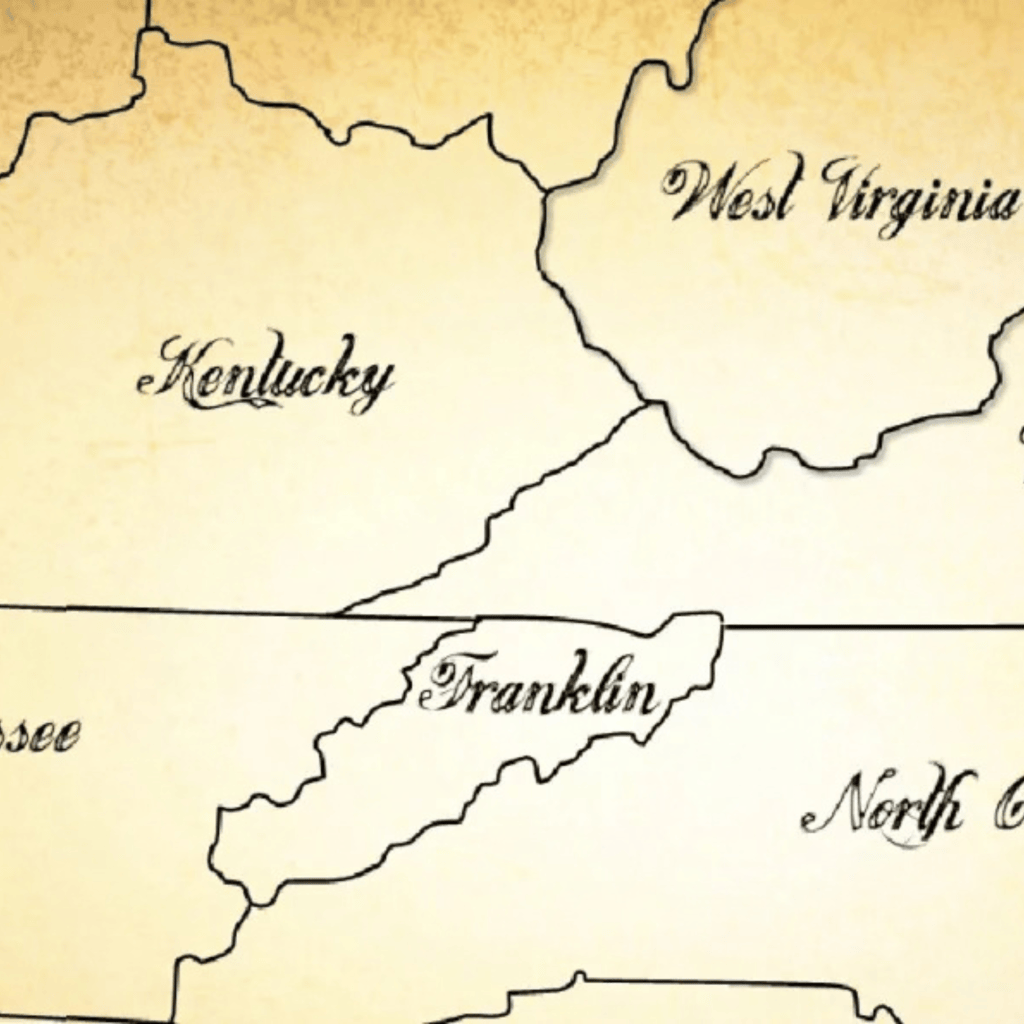
In response to the state’s cession, three counties in the western lands – Washington, Sullivan, and Greene – felt that statehood seemed logical. Communications with eastern North Carolina were difficult, and the settlers believed that state officials along the coast couldn’t represent their interests. Thus, the concept of Franklin was born in August 1784.
The separatists issued their own declaration of independence. This declaration aired their grievances against the North Carolina government, which included the fact that the distance of the east made it difficult for the government to respond promptly to attacks by Native Americans and their perception that officials looked down upon the western settlers. It was also written that land warrants would be validated by Franklin rather than the federal government or North Carolina, since they were seeking statehood.
In November, state elections resulted in the ousting of the framers of the Land Grab Act, and one of the first decisions made by the new legislature was to repeal the cession of land to the federal government. The framers of the act ultimately supported the repeal because, with Franklin’s potential for becoming a state, it was important for North Carolina to maintain sovereign control of the western territory. If Franklin gained control, the previously issued land warrants would be invalidated by the new state government.
Although the new legislature repealed the proposed cession, a constitutional convention was held for the state of Franklin in Jonesborough, with delegates from each county in attendance.
At the convention, a resolution was put forth to officially separate from North Carolina. It passed, but not without pushback from some delegates. Subsequently, the delegates drafted and adopted a temporary constitution that closely mirrored that of North Carolina’s. They decided to run with this draft for up to a year.
In March 1785, the Franklinites, if you will, held their first general assembly. For governor, they elected the charismatic war hero John Sevier.
Originally from Virginia, John Sevier made his way to the western lands of North Carolina in pursuit of cheap, plentiful land. After relocating in 1773, he served as the leader of the Watauga Association, a self-governing entity with the goal of maintaining order west of the Appalachian Mountains. John Sevier also served in the Revolutionary War. In 1780, he served as a colonel in the Battle of Kings Mountain and led a militia against British-allied Cherokee forces in the Battle of Boyd’s Creek. It’s reported that he fought in 35 battles and won all of them. Needless to say, John Sevier was a popular figure among western North Carolina settlers.
Additionally, at Franklin’s March 1785 general assembly, four new counties were created: Wayne, Spencer, Caswell, and Sevier. Following the assembly, frontier pioneer and military leader William Cocke was tasked with addressing Congress with the request for recognition and admission of Franklin into the Union as the 14th state. In May, this request was denied.
In the following June, John Sevier met with leaders of the Cherokee tribe at Dumplin Creek in hopes of gaining additional land south of the French Broad River. The two parties would agree to the Treaty of Dumplin Creek; however, the parties came away from the meeting with different interpretations. While Sevier interpreted the treaty as granting the settlers permission to claim the entire region between the French Broad and Little Tennessee Rivers, the Cherokee claimed to only have allowed white families already living in the region to remain. Once this region was announced to be open for settlement, settlers moved in immediately. The state of Franklin made itself the authority for legitimizing land claims.
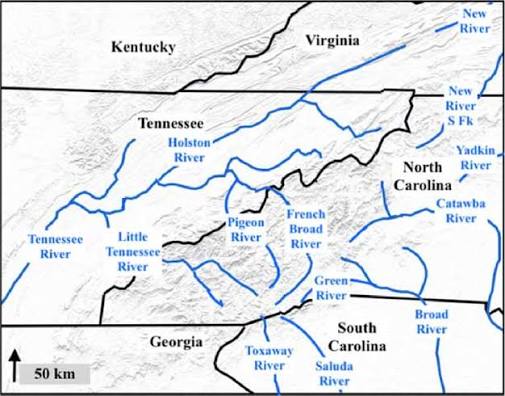
The aspiring state’s second constitutional convention was held in Greeneville in November 1785. In search of a permanent constitution, delegates put forth the Houston Constitution, written by Reverend Samuel Houston and university president Dr. William Graham. This document suggested Franklin be renamed Frankland, meaning land of free men; allowed adult white males the right to vote without property qualifications; prohibited lawyers, ministers, doctors, and anyone deemed to have an immoral character from holding public office; and called for a single-chamber legislature, in which all public bills would be submitted directly to the public for debate and approval before becoming law. After ensuing debates, it was rejected.
Reverend Samuel Houston refused to accept the rejection of his proposed constitution and moved to have it held out for public consideration. He travelled to Philadelphia, paid for prints of campaign pamphlets in support of his constitution, and gave them to his jurisdiction’s citizens. Instantly, the population was divided. Tensions grew so terribly that protests against the Houston Constitution included the burning of Dr. William Graham in effigy.
Meanwhile, representatives of the U.S. government met with leaders of the Cherokee at the Hopewell Plantation, in what is presently known as Clemson, South Carolina. During the meeting, the Cherokee’s negotiations with John Sevier were ignored. As a result, it was established that a large portion of Franklin was well within the boundaries of the Cherokee Nation. The thousands of settlers encroaching on Cherokee land were told to leave, and if they hadn’t within six months, they forfeited any protection provided by the U.S. government. Settlers of Franklin ignored the demand.
The period following the agreement at Hopewell saw intermittent hostility between those of Franklin and the Cherokee Nation. In 1786, John Sevier and other Franklin leaders met with the Cherokee once again. Using military intimidation, they forced Cherokee leaders to re-verify the boundaries established at Dumplin Creek and surrender even more land. Franklin would go on to add another county – Blount County – but violence between the two populations continued.
The same year, John Tipton, a political dissenter who voted against the resolution to form a sovereign state, was appointed as a senator for Washington County. He was tasked with re-establishing North Carolina’s authority.
Out of Franklin, John Sevier was governing the illegitimate state of Franklin, and John Tipton was building and leading a movement loyal to the North Carolina government. By the end of 1787, a good portion of Franklin’s population rallied under Tipton’s leadership.
In February 1788, John Tipton persuaded a local sheriff to seize several of John Sevier’s slaves; the excuse being Sevier’s refusal to pay North Carolina taxes. Tipton held the slaves at his residence.
Thereafter, Sevier led a militia to Tipton’s cabin, where the two sides exchanged gunfire for over two days. The battle ended with North Carolina loyalists from Sullivan County successfully launching a surprise counter-attack on Sevier’s militia. This would be known as the Battle of Franklin.
After this tiff, Franklin deteriorated quickly.
John Sevier sought potential annexation from Esteban Rodríguez Miró, the Spanish governor of New Orleans. Rather than annexation, all Sevier got from these communications was charges of treason by the state of North Carolina. While awaiting trial, an armed group of separatists broke him out of jail.
John Sevier settled south of the French Broad among a population staunchly loyal to him. In February 1789, he and other Franklin leaders took the oath of allegiance to North Carolina out of political survival; taking the oath was required to secure a formal pardon for his criminal charges. Within less than a year of Franklin’s collapse, with his popularity remaining high among western settlers, Sevier was elected to the North Carolina State Senate.
Holding a position in the state senate allowed John Sevier to work to get North Carolina to cede its western lands to the federal government, making the western lands the Southwest Territory. President George Washington appointed William Blount, a wealthy politician with ties to the federal government, to govern the newly formed territory. Blount then appointed Sevier as a general of the territorial militia. Eventually, a territorial census provided evidence of a large enough population for statehood. In January 1796, Blount and Sevier called a constitutional convention in Knoxville to draft a state constitution.
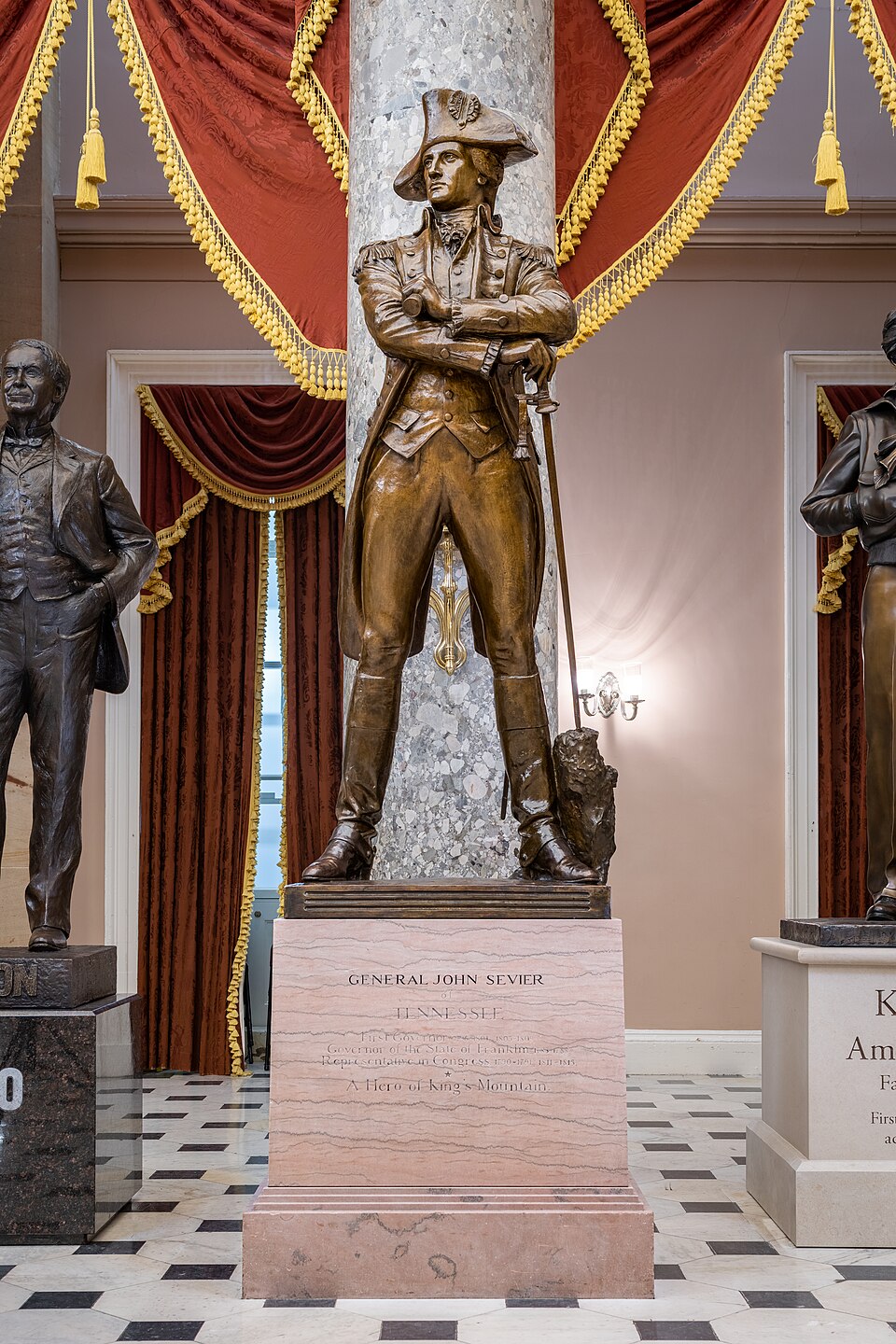
The first state elections took place that March, resulting in John Sevier being elected the first governor of Tennessee. In June, Tennessee was officially admitted as the 16th U.S. state by President Washington. Sevier went on to serve as governor of Tennessee for 12 years: his first set of three consecutive two-year terms began in 1796 and the second set began in 1803.
With all of this being said, the chaos surrounding Franklin greatly concerned the nation’s Founding Fathers. So much so, in fact, that it directly influenced the creation of the New States Clause in the U.S. Constitution: “…but no new State shall be formed or erected within the Jurisdiction of any other State; nor any State be formed by the Junction of two or more States, or Parts of States, without the Consent of the Legislatures of the States concerned as well as of the Congress.”
And, while John Sevier failed epically to become the Father of Franklin, he successfully became the Father of Tennessee, making him an important figure in the entire country’s history.
“In the execution of the duties of my office, I shall always be guided by a desire to promote the public welfare, and to maintain the peace, dignity, and safety of the state.” – John Sevier, 1796.


Leave a comment